U.S. PERSPECTIVES Affluent consumer spending is under pressure
October 13, 2016 - After leading post-recession spending growth, affluent U.S. consumers1 have pulled back on spending in recent years. A key consumer segment, the affluent represent 20 percent of U.S. households but account for nearly 40 percent of consumer credit spending.
Since 2012, non-affluent consumers have played a more important role in driving spending growth, benefitting from strong job growth in lower- and middle-income wage tiers and disproportionate gains from low gas prices. During that period, affluent spending lagged as much as five percentage points behind non-affluent spending growth. Non-affluent consumers led spending growth since mid 2012.
Three main reasons were identified for the slowdown in affluent spending growth:
- Affluent consumer spending closely tracks with inflation. Lower prices actually cause a reduction in affluent spending and the affluent are more likely to pocket the savings from a drop in prices. Non-affluent consumers, on the other hand, typically spend their windfall.
- Negative wealth effects from weak stock gains have weighed on affluent consumers, who hold most of the stock wealth. Stock market volatility has less impact on non-affluent consumers, whose wealth is more closely tied to home ownership. Non-affluent spending has increased with recent steady gains in home values. One clue to the affluent spending dilemma: the Visa Luxury Spending Index, which shows a strong correlation between the S&P 500 and spending at luxury stores, has stagnated over the past 18 months due to limited stock market growth and volatility.
- Affluent baby boomers are spending less. Most boomers (now aged 52 to 70) are past their peak spending years—spending peaks on average at age 46, but slightly later for the affluent (age 54). As boomers reign in their spending and prepare for retirement, they leave a void that cannot be filled by Generation X, a smaller population group.
Consumer Credit Spending2
(Year-over-year Growth by Annual Household Income)
Last actual: Q2 2016
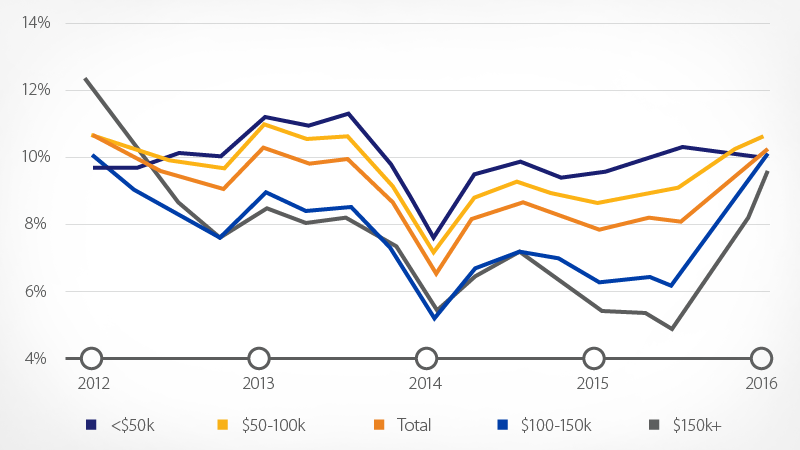
Sources: VisaNet; Visa Business & Economic Insights; TransUnion LLC; Acxiom.
However, affluent spending is showing signs of life. Increasing inflation and positive wealth effects from a rising stock market helped lift affluent spending growth by 8.8 percent in the first half of 2016, yet still slower than non-affluent spending, which grew by 10.0 percent.

Corrine Fusso, Associate Economist
Corrine Fusso is an associate economist with the Business and Economic Insights team at Visa. Prior to joining Visa, Fusso worked as a business intelligence consultant for Microsoft and JSTOR, where she analyzed data and provided insights to influence business decisions. Fusso has bachelor’s degrees in economics and international studies, both from the University of Washington in Seattle. She also earned an M.A. degree in economics from Claremont Graduate University. Fusso is the president of the San Francisco chapter of the National Association of Business Economics.
Notes
1 Affluent households have income greater than $100,000.
2 Adjusted for leap year.
You may also be interested in
U.S. consumer spending reveals economic growth
Solid macroeconomic factors like more jobs are supporting consumers and their ability to spend.

Brexit: Long-term impact on travel is unknown
Learn how Brexit could impact international travel from the U.K.
Cross-border credit card spending in Brazil
Learn how to capture more Brazilian consumer cross-border spending on credit cards.